Florence & Regulatory Documentation
A regulatory binder is the central repository for the essential documents that demonstrate that a research study has been appropriately approved, conducted, supervised, and documented. It provides an organized record of the study from initial approval through study closeout and serves as an important resource for the research team, institutional oversight groups, study monitors, sponsors, and regulatory authorities.
Regulatory binders typically contain documents such as the study protocol and amendments, IRB submissions and approvals, informed consent documents, investigator and study staff qualifications, delegation and training records, safety information, and other documentation necessary to establish how the study was conducted and how regulatory requirements were met. The exact contents will vary depending on the type of study, its funding and regulatory status, and institutional requirements.
Every research study must maintain a complete and up-to-date regulatory file containing the essential documents applicable to that study. Maintaining these records is not simply an administrative task—it is a fundamental part of responsible research conduct. A well-maintained regulatory binder helps document protocol compliance, protects the integrity of the research record, facilitates appropriate oversight, and ensures that information can be readily located if questions arise during the study or during an audit, monitoring visit, or inspection.
Using Florence to Maintain the Regulatory Binder
Florence eBinders is an electronic regulatory document management system designed specifically for clinical research. Rather than maintaining regulatory materials in a traditional paper binder or across multiple folders and shared drives, Florence allows study teams to maintain an organized electronic Investigator Site File (eISF), often referred to as an electronic regulatory binder or eBinder.
Within Florence, study teams can organize, store, review, electronically sign, and track study documents throughout the life of a study. The platform provides a structured location for regulatory records while also supporting document histories, electronic signatures, user permissions, and other tools that make it easier to determine whether required documentation is complete and current. Florence can also facilitate collaboration with authorized monitors and other external study partners when appropriate.
For studies using Florence, the Florence eBinder should be treated as the study's official regulatory binder, not simply as an optional document-storage location. Study staff should upload and file regulatory documents as they are generated, ensure that outdated materials are appropriately superseded or archived, obtain required signatures in a timely manner, and routinely review the binder for completeness. Keeping the binder current throughout the study is substantially easier—and more reliable—than attempting to reconstruct the regulatory record later.
Ultimately, the goal is for the regulatory binder to provide a clear, complete, and contemporaneous record of the study's conduct from startup through closeout. Florence provides a centralized electronic system for maintaining that record and making regulatory document management a routine part of study operations rather than an end-of-study administrative exercise.
Florence eBinder Set Up
The following are the materials that typically need to be maintained on Florence:
Staff Documents (Expire every 2 years)
CVs
CITIs
Medical Licenses
MRI training (annual renewal)
Logs (Adobe)
Study DOA logs (e.g., K23, tDCS, etc.)
Study Training Log (e.g., K23, tDCS, etc.)
PSG training Log
Stimulation Training Log
Logs (not Adobe)
Study Enrollment Logs (e.g., K23, tDCS, etc.)
Study Eligibility Logs (e.g., K23, tDCS, etc.)
Consent documentation
Study Documentation of Consent Checklists
Signed Study e-consent
Study Documents
Clinical Screen Documents
Quest Results
Scheduler email thread as PDF (for clinical screening and study visits)
Note to files (as needed)
Lab Documents
Lab meeting Agendas
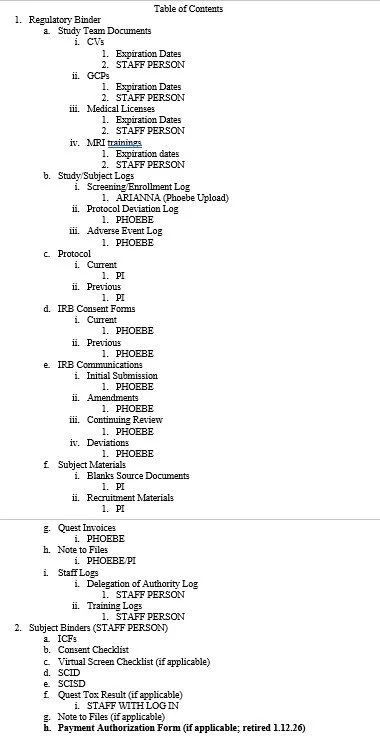
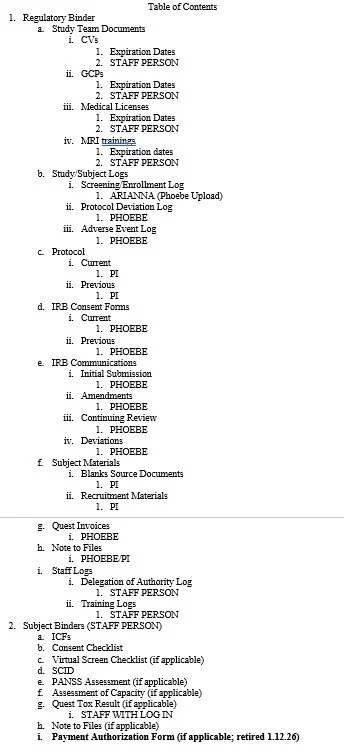
Template Table of Contents for Study Florence eBinders
The following are example table of contents for previous study binders in the lab. Future studies should largely model the development of their regulatory binders to be similar.