
CfSC Poster Development Timeline
Developing an academic poster in the Center for Sleep and Cognition
Congratulations on taking on the development of a scientific poster with our lab! This is an exciting opportunity to translate research into a clear, visually engaging format and to share your work with a broader scientific audience. Poster presentations are a key part of scientific communication and can be an important part of professional development with the potential of leading to future presentations and publications.
At the same time, developing a high-quality poster requires thoughtful planning, clear communication, and adherence to a structured timeline. Because abstract submission deadlines for poster presentations are often fixed and non-negotiable, the process is intentionally compressed. The timeline below is designed to help you stay on track and ensure that your final product is polished, accurate, and presentation-ready.

Poster Abstract Timeline & Benchmarks
6 months before abstract submission deadline - Identify topic and scope
You should define the topic of your poster and the general scope of the project. This includes identifying the dataset or research question you will focus on and ensuring feasibility within the timeline. Get approval from your primary mentor before proceeding.
5 months before abstract submission deadline - Select target conference/opportunity
Identify the specific conference, symposium, or event you plan to submit to. Carefully review submission guidelines, formatting requirements, and abstract deadlines, as these will shape the remainder of your timeline. A list of common local and national poster presentation opportunities can be found here, but you are welcome to seek out others. Confirm the selection will be appropriate for your work with your primary mentor.
4 months before abstract submission deadline - Draft a rough outline of your abstract
Prepare an initial rough draft of your abstract and a structured outline of your poster (Introduction, Methods, Results, Conclusion), taking into consideration any requirements set by the event. This should clearly communicate your research question, approach, and anticipated contribution. At this stage you should also identify other co-authors supporting the work and determine the planned authorship order.
3.5 months before abstract submission deadline - Finalize dataset for analysis
Your dataset should be cleaned, organized, and finalized in a master file suitable for analysis (e.g., R, SPSS). Ensure variables are clearly labeled and any data issues have been addressed.
2 months before abstract submission deadline - Develop and confirm analyses
You should first attempt to determine appropriate analyses independently. Then meet with your primary mentor to review and confirm your analytic plan to ensure accuracy before proceeding.
1.5 months before abstract submission deadline - Generate figures and tables
Create initial versions of all figures, tables, and visualizations relevant to your analysis. While these will likely not be needed for the abstract submission, they are typically critical for accurate interpretation of the results. These should be clear, interpretable, and aligned with your research questions. The goal is for them to be repurposed for your poster and poster presentations rely heavily on visuals, so clarity here is critical.
1 month before abstract submission deadline - Draft final abstract and send to coauthors
Prepare written content for all sections (Introduction, Methods, Results, Conclusions). Confirm the format and requirements (e.g., word count) of the opportunity you are targeting. Text should be concise, readable, and tailored for a poster format (i.e., not dense paragraphs). Send to your primary mentor and all co-authors for review. *Failure to meet this deadline may delay your submission. While work may continue, you would have to select the next appropriate opportunity.*
Tips on writing an abstract can be found here and here. A selection of previously submitted abstracts can be found in the CfSC Production folder in the CfSC Sharepoint.
2 weeks before abstract submission deadline - Co-author feedback and revisions
You will receive detailed feedback and required revisions from your co-authors. At this stage, you may need to run additional analyses or incorporate other considerations. The advisor may request additional back and forth beyond the final steps listed below depending on what needs to be addressed.
1 week before abstract submission deadline - Revised draft returned to co-authors
Send your revised draft incorporating all feedback to your primary mentor and co-authors. This version should be near-final. *Failure to meet this deadline may delay your submission. While work may continue, you would have to select the next appropriate opportunity.*
2 days before abstract submission deadline - Advisor returns final edits
Final comments and minor edits will be provided. Turnaround time is short, so you should be prepared to make prompt adjustments.
Day of abstract submission deadline - Submit abstract
Submit your finalized abstract according to the opportunities requested methods
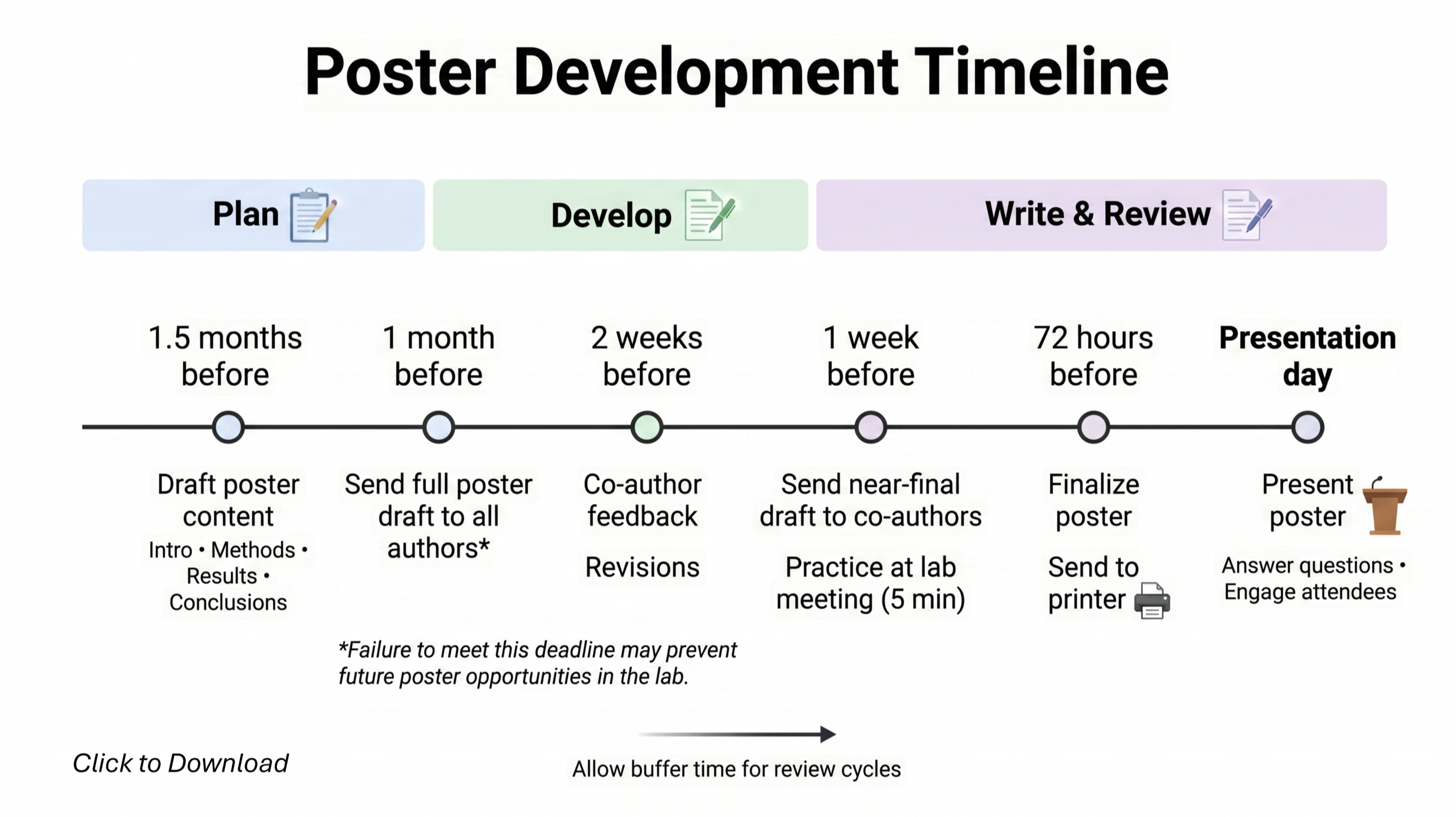
Poster Development Timeline & Benchmarks
If your poster is accepted, congratulations! 🎉🎉Notify your primary mentor right away so you can celebrate and start planning the development of the poster itself. The following timeline should be used to support this development.
1.5 months before presentation - Draft poster content
Using your abstract, draft written content for all sections (Introduction, Methods, Results, Conclusions). Text should be concise, readable, and tailored for a poster format (i.e., not dense paragraphs).
1 month before presentation deadline - Send full poster draft to all authors
Submit a complete draft of the poster, including layout, text, and figures to your primary mentor and all co-authors associated with the project. Make sure you are developing it to be the correct size (all poster sessions provide guidelines on this). This should resemble a near-final version rather than a conceptual draft. *Failure to meet this deadline may prevent future poster opportunities in the lab.*
Tips for making posters can be found here and here. A video describing a newer style of poster can be found here and here. A selection of previously submitted posters can be found in the CfSC Production folder in the CfSC Sharepoint, and it is highly recommended that you use a previously submitted one as the primary template, or a BIDMC-approved template.
2 weeks before presentation deadline - Co-author feedback and revisions
You will receive feedback on both scientific content and visual presentation. Revisions at this stage may be substantial and should be addressed carefully.
1 week before presentation deadline - Send final poster draft to co-authors | Practice Presentation at lab meeting
Send a revised, near-final version incorporating all feedback to your primary mentor and co-authors. At this stage, only minor edits should remain. Also arrange to present a 5-minute walk through of your poster at a lab meeting prior to your presentation day.
You want to develop a clean, professional walk-through of your poster for those that visit your poster. This should be ~5 minutes. Tips on developing concise, “elevator pitch” presentations can be found here, here, here, here, and here.
72 hours before presentation deadline - Incorporate any final edits and send poster to printer
Incorporate any final edits from your mentor and co-authors and submit your finalized poster for printing. Printing delays and formatting issues are common, so this buffer is essential. We typically use PhD Posters with pick up in the nearby MASCO building.
Presentation day - Present poster
Be prepared to clearly and confidently present your work, answer questions, and engage with attendees.
Final Notes
Developing a scientific poster is a fast-paced but highly rewarding process. We are excited to support you as you refine your ideas and prepare your work for presentation.
At the same time, adherence to this timeline is essential. Because poster submissions and printing timelines are often inflexible, missed deadlines can significantly impact the quality of the final product. If benchmarks are not met, we may not be able to support submission or sign off on the poster and/or it may limit our ability to support future attempts.
These expectations are in place to ensure that you have a structured, efficient, and rewarding experience—and that you produce a final product you can be proud to present. Further, a well done poster can be re-used at more than one event as long as you are sure it will be a novel audience (speak to your primary mentor about this potential), so investing the appropriate amount of time on the front end can go even further to enhance your professional development.